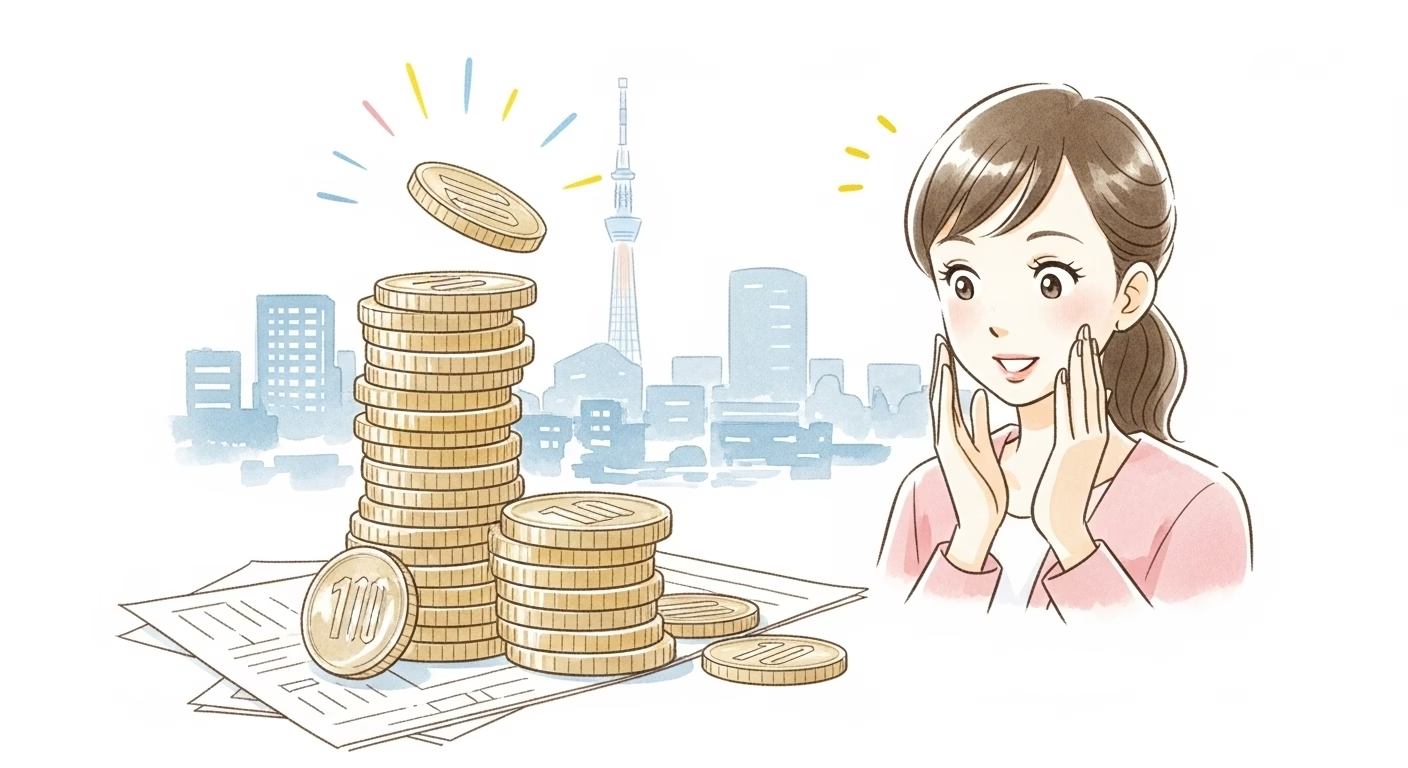
Have you heard the words “BOJ” (Bank of Japan) or “ETF” in the news recently?
It sounds kind of difficult, so it’s easy to just let it go in one ear and out the other, isn’t it?
But actually, this is a huge story that is directly connected to our daily lives and our savings for the future.
#PIC2
The Bank of Japan currently holds an incredible amount of Japanese stocks.
The profit from these stocks is said to be as much as 20 trillion yen.
“If they have that much money, they should lower taxes or distribute it to us!”
You might think that. I thought so too at first.
But when I looked into it, it seems it’s not that simple.
If they move this money carelessly, our NISA assets might decrease, or prices of goods might go up.
Today, I will unravel this slightly complex but important story about the “BOJ’s ETFs” in simple terms, without using technical jargon.
Grab a coffee, relax, and read on.
Actually the Biggest Shareholder in Japan? The True Identity of the “ETF” Held by the BOJ
First, let’s start with “What is an ETF?”
Simply put, it’s like a “lucky bag containing stocks from various companies.”
Instead of buying stock in one specific company, the BOJ has been buying these lucky bags (ETFs) in a way that is like buying the entire market.
Since When? The Total Amount of Stocks Bought and the “20 Trillion Yen” Unrealized Gain
It was more than 10 years ago that the BOJ started this “buying spree.”
The purpose was to improve the Japanese economy.
They thought that if they bought stocks and supported stock prices, everyone’s mood would brighten and the economy would turn around.
As a result, what do you think happened?
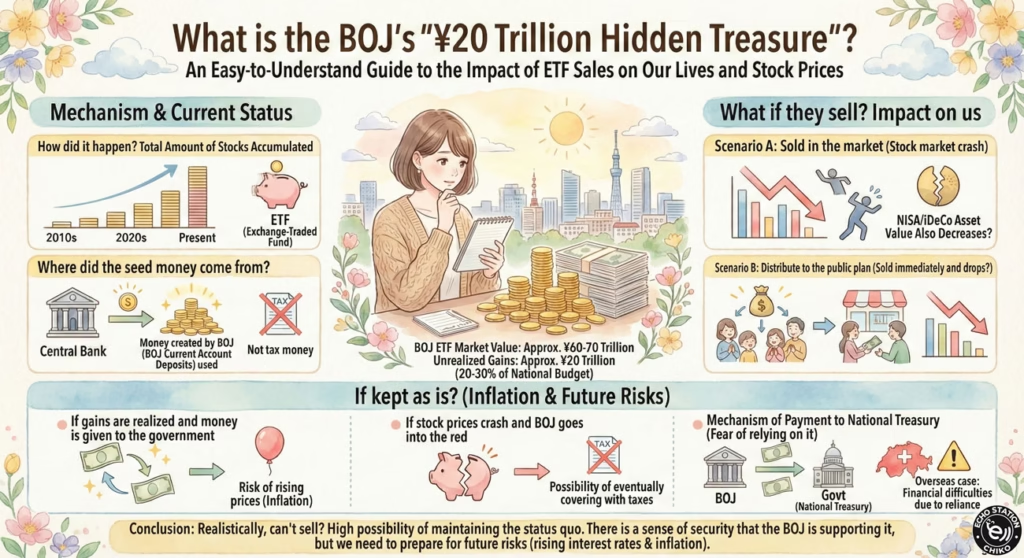
Currently, the market value (current value) of the stocks held by the BOJ is estimated to be between 60 trillion and 70 trillion yen.
If you subtract the amount they paid when they bought them, the profit (unrealized gain) alone is about 20 trillion yen.

Even if I say 20 trillion yen, it doesn’t really ring a bell, does it?
Japan’s national budget (general account) is about 110 trillion yen, so this amount is equal to about 20% to 30% of that.
If this were a temporary bonus, it would be a tremendous amount.
Holding this much stock means that the BOJ has effectively become something like the “largest shareholder in Japan.”
Where Did the Money Come From? Is Our Tax Money Being Used?
Here, there is one thing you might be wondering about.
“Is the money used to buy those stocks our tax money?”
Please rest assured. This is not tax money.
So where did it come from? It is money that the BOJ created itself.
Since the BOJ is a central bank, it can issue money.
To be precise, they create money by increasing the numbers in an account called “BOJ current account deposits.”
It’s a bit like magic, but the image that fits best is:
“They printed new money and bought stocks with that money.”
They created a huge profit without hurting their own pockets, so it looks like amazing alchemy.
But that is exactly why the “exit” is difficult.
What Happens if the BOJ Sells the ETFs? The “Impact” on Us
Now, this is the main topic.
“If they are making such a profit, they should just sell quickly and lock in the profit,” you might think.
But if the BOJ decides, “Okay, let’s sell!”, what kind of impact will it have on our lives?
Let’s consider a few scenarios.
Scenario A: Selling in the Market (Impact on Stock Prices)
The simplest method is to sell normally in the stock market.
But this is also the most dangerous method.
Imagine this.
What would happen if the BOJ, the largest shareholder in Japan, declared “We are selling our stocks!”?
The market would panic.
“If the BOJ sells, stock prices will go down! Let’s escape while we can!”
Investors all over the world would start selling stocks all at once.
#PIC4
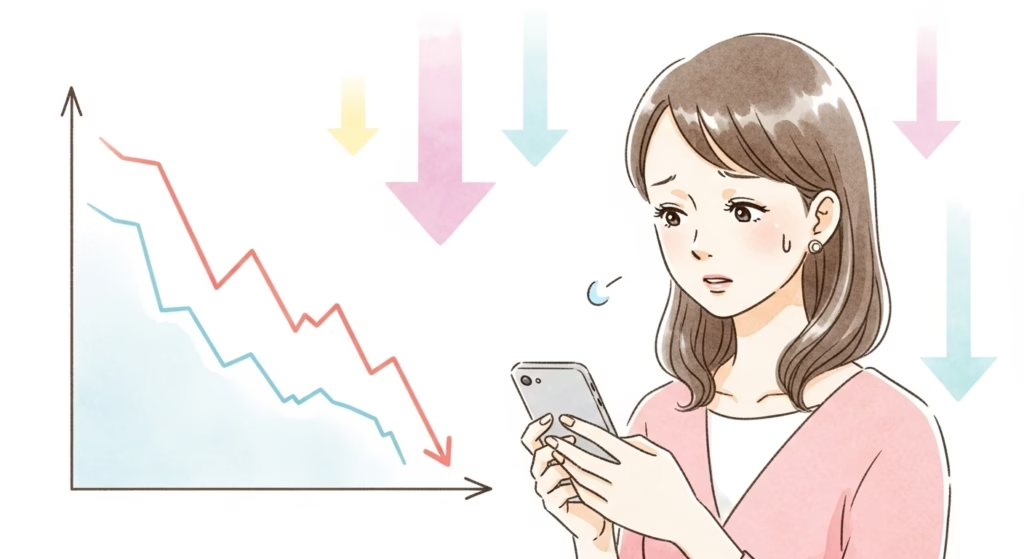
As a result, stock prices would crash. Some people call this the “BOJ Shock.”
If this happens, there will be direct damage to us too.
For example, the “Tsumitate NISA” or “iDeCo” that we are steadily building up for the future.
The asset value of these could drop drastically.
The investment gains that had finally increased might turn into a minus in an instant.
That is why the BOJ cannot easily say “We will sell.”
Scenario B: Distributing to the People? Merits and Demerits of the “Stock Distribution” Plan
Then, how about distributing them to the citizens instead of selling?
“We present everyone with ETFs worth XX yen!”
If we were told that, we would be happy at first, right?
Some experts have even proposed such an idea.
But there is a trap here too.
If you received an ETF, what would you do?
“Yay! I’ll sell it immediately for cash and eat something delicious!”
I think many people would think that way.
If many people try to sell and cash out all at once, it will end up being the same as Scenario A.
Sell orders will flood in, and stock prices will crash.
In the end, the economy could get worse, and there is a risk that our salaries won’t go up.
What Happens if They Keep Holding? (Inflation and Taxes)
“If selling is no good, why not just hold them forever?”
There is also that way of thinking.
Actually, this might be the most realistic option for now.
But it doesn’t mean the risk is zero.
Suppose the BOJ locks in the profit and gives that money to the government.
If the government uses that money as a budget, the amount of money circulating in the world will increase rapidly.
If there is too much money, there is a fear that “inflation,” where the prices of goods go up, will advance.
Don’t you feel that shopping at the supermarket has been a little expensive lately?
That kind of price increase might become even more intense.
Also, there is a risk if stock prices fall significantly in the future.
What would happen if stock prices crashed and the ETFs held by the BOJ went into the “red”?
If the BOJ’s safe becomes empty, in the worst case, there is a non-zero possibility that our taxes will be used to fill that hole.
Just holding onto them is like holding a bomb.
Whose Money is the Profit? The Mechanism of “Payments to the National Treasury”
Here, let’s talk a little about the law.
“If they manage to sell successfully, whose property does that profit become?”
That is the question.
#PIC5
The Rule is that BOJ Profits Become Government Income
Actually, it is decided by a law called the Bank of Japan Act.
The remainder of the profits earned by the BOJ, after deducting necessary expenses, must be paid to the government as “Payments to the National Treasury.”
In other words, it ultimately becomes “national income.”
If it becomes national income, it should be money used for the citizens.
It might be used for social security or to repay debt.
Thinking about it that way, it seems there are benefits for us too.
The “Danger of Relying on It” Seen from Overseas Examples (Switzerland)
However, relying too much on this money is dangerous.
There is a slightly scary example overseas.
The central bank of Switzerland also holds a lot of stocks, just like Japan.
In Switzerland, there were several local governments that made budgets relying on the distribution of profits from the central bank.
“We will get money from the central bank again this year, so let’s build a new facility.”
They were planning like that.
However, one year, stock prices fell and the central bank went into the red.
Naturally, the money for the local governments became zero.
The local governments that had relied on that money panicked and had to cut budgets or cancel plans.
Stock profits are uncertain things.
Designing the operation of the country or our lives based on “easy money” that we don’t know when will disappear is a very dangerous thing.
[Conclusion] Is There an Exit After All? Future Outlook
Having looked at this so far, I hope you have understood somewhat how complex the BOJ’s ETF problem is.
Finally, let’s summarize the outlook for the future.
Realistically “Cannot Sell”? Possibility of Holding Semi-Permanently
There are various opinions, but for now, the option of “selling immediately” seems unlikely.
Because the shock to the market would be too big.
The most likely scenario is:
“Keep holding without selling, and receive only the dividends that come in every year.”
This is a form of maintaining the status quo.
In this way, they can pay profits to the country little by little without causing stock prices to crash.
It seems there is no choice but to solve it little by little over a mind-bogglingly long time.
#PIC6
What We Investors Should Keep in Mind
What can we individuals do?
First, do not be too off guard thinking “I’m safe because the BOJ is supporting the market.”
We never know what will happen to stock prices.
- Do not concentrate on specific assets (Diversified Investment)
- Invest with the intention of holding for a long time (Long-term Investment)
Let’s not forget these investment basics.
The BOJ’s movements are like a weather forecast.
If you know “It looks like it will rain today,” you can go out with an umbrella, right?
When you see the news and feel “Oh, the BOJ might move,” review your asset allocation.
If you respond calmly like that, you will be fine.
Answering Reader’s Doubts! Q&A Corner
Here, I have summarized common doubts in a Q&A format.
#PIC7
Q1. What will happen to my NISA from now on?
A. There is little worry of an immediate crash, but let’s watch over it with a long-term view.
It is hard to imagine the BOJ suddenly selling all its stocks. However, stock prices are things that go up and down repeatedly. When news about the BOJ comes out, price movements might become a little rough, so it is best to continue steadily without reacting to every little thing.
Q2. Won’t the 20 trillion yen profit be given to us in cash?
A. The possibility of it being distributed in cash is currently low.
Even if they were to distribute it, there is a risk of inviting inflation (rising prices), so the government is also cautious. It is more likely that it will be used to repay national debt rather than us receiving cash directly.
Q3. When will this problem be solved?
A. It looks like it will be a long story spanning decades.
Because the amount is too large, it is not a problem that can be solved in a few years. It might be that the BOJ will still be holding stocks even when we are old enough to receive our pensions.
Summary
I have spoken roughly about the BOJ’s ETF problem.
- The BOJ has a profit of 20 trillion yen, but cannot easily turn it into cash.
- If they sell forcibly, there is a risk of a stock market crash and inflation.
- Let’s protect our assets at our own pace without relying on “easy money.”
When you hear the number “20 trillion yen,” it sounds like a dream, but reality is quite severe.
But once you know the mechanism, there is no need to be more afraid than necessary.
From now on, when you see news about the BOJ, please try looking at it from a slightly different perspective:
“Oh, that story about the buried treasure. I wonder how they will look for an exit?”
Economic news should feel a little closer to you than before.
<div style=”border: 1px solid #ddd; padding: 20px; background-color: #f9f9f9;”>
[Description]
What is the BOJ’s 20 trillion yen ETF profit? I explain the impact of a potential sale on our NISA accounts and daily lives in simple terms, without jargon. Learn about the risks of a stock crash and what we should do.
[Keywords]
Bank of Japan, BOJ, ETF, 20 trillion yen, impact, NISA, easy explanation, exit strategy, inflation, stock market
[Slug]
boj-etf-impact-explanation
</div>