




Toyota remains financially strong but strategically conflicted.
Its hybrid success masks deeper ESG and governance risks.
Investors should treat Toyota as a value stock with long-term transition uncertainty.
A Deep, Investment-Oriented Look at Toyota’s ESG Reality
Sustainability sounds good on paper.
But when a company is as large as Toyota, slogans alone are meaningless.
Toyota is not just another automaker. It is the world’s largest.
When Toyota delays, accelerates, or resists change, the global market feels it.
This article is not about praising Toyota, nor about attacking it.
It is about understanding whether Toyota’s sustainability strategy reduces long-term risk or quietly creates new ones—especially from an investment perspective.
Why Toyota’s Sustainability Deserves Scrutiny Now
Toyota sits at the center of three powerful forces:
- Global decarbonization pressure
- Rapid technological disruption
- Rising ESG-driven capital allocation
For years, Toyota was celebrated as an environmental pioneer thanks to the Prius.
Today, it is criticized by environmental NGOs and ESG investors for moving too slowly on full electrification.
This gap between reputation and reality is exactly why Toyota is worth examining now.
Company Overview and Business Structure
Toyota operates in more than 170 countries and regions, selling over 10 million vehicles annually.
Its scale alone makes its environmental and social impact unavoidable.
Its core business spans multiple powertrains:
- Hybrid vehicles (HEV)
- Plug-in hybrids (PHEV)
- Battery electric vehicles (BEV)
- Hydrogen fuel-cell vehicles (FCEV)
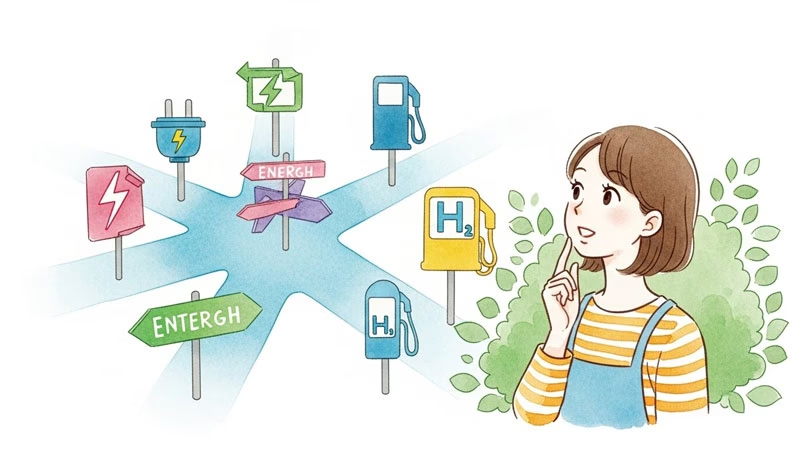
Unlike peers that committed early to BEVs, Toyota chose diversification.
This strategy reduces short-term risk—but may amplify long-term uncertainty.
Why Sustainability Is Especially Critical for Toyota
The auto industry is undergoing a structural reset.
Internal combustion engines—Toyota’s historical strength—are becoming liabilities under tightening climate regulations.
At the same time, software-defined vehicles and battery supply chains are reshaping competitive advantage.
Toyota’s challenge is not survival today.
It is relevance ten years from now.
Environmental Performance: Serious Action or Strategic Delay?
Toyota’s “Multi-Pathway” Strategy Explained
Toyota argues that the world is not uniform.
Charging infrastructure, power grid cleanliness, and income levels differ widely.
Its response is a “multi-pathway” approach—offering multiple technologies instead of betting everything on BEVs.
This sounds pragmatic.
But pragmatism can quietly become resistance.
The “1:6:90” Battery Argument
Toyota frequently cites a resource-allocation logic:
- Battery materials for 1 long-range BEV
- Could produce 6 PHEVs
- Or 90 HEVs
Toyota argues that deploying 90 hybrids reduces more total emissions today than deploying 1 BEV.
This logic assumes battery scarcity and short-term optimization.
It does not solve the long-term requirement of near-zero emissions.
Emissions Data: What the Numbers Say
Toyota reports strong progress in operational emissions.
- Scope 1 and 2 emissions in North America fell about 32% compared to 2019
https://pressroom.toyota.com/toyota-releases-2025-north-american-environmental-sustainability-report/
However, the larger issue is Scope 3 emissions.
- Toyota’s total 2024 greenhouse gas emissions were about 589 million tons CO2-equivalent
- Roughly 432 million tons came from vehicle use
https://www.greenpeace.org/eastasia/blog/68419/toyotas-2024-ghg-emissions-reach-589-57-mt-co₂e-greenpeace-response/
Operational efficiency is impressive.
Product emissions remain overwhelming.
Recycling and Circular Economy Efforts
Toyota recycled or reused approximately 93% of its manufacturing waste in 2023.
https://pressroom.toyota.com/toyota-releases-2024-north-american-environmental-sustainability-report/
It is also investing in battery recycling partnerships to recover lithium, nickel, and cobalt.
These actions reduce future cost risk and supply vulnerability—an important investment signal.
Environmental Risks Investors Should Not Ignore
- Toyota has received a “D” rating from InfluenceMap for climate lobbying
https://electrek.co/2024/05/14/toyota-once-in-again-ranked-as-worst-automaker-on-climate-lobbying-globally/ - Toyota has lobbied governments to delay or weaken EV mandates
- Marketing language such as “self-charging hybrid” has drawn regulatory scrutiny
https://www.theguardian.com/business/2023/mar/03/toyota-accused-of-greenwashing-in-greenpeace-complaint-filed-to-accc
From an ESG investment lens, policy behavior matters as much as factory emissions.
Social Responsibility: Strengths with Structural Blind Spots
Employees and Labor Relations
In Japan, Toyota remains a stable employer.
It agreed to significant wage increases during recent labor negotiations.
This supports workforce resilience and reduces operational disruption risk.
Supply Chain Human Rights Risks
Toyota’s supply chain includes aluminum and steel sourcing linked to China’s Xinjiang region.
Human rights organizations warn of forced labor risks across the auto sector, including Toyota.
https://www.hrw.org/news/2024/02/01/china-carmakers-implicated-uyghur-forced-labor
Transparency is limited.
For investors, this represents regulatory and reputational exposure—especially under US import laws.

Diversity and Inclusion
Toyota ranks highly in US diversity evaluations.
https://pressroom.toyota.com/toyota-ranks-4th-on-fair360s-top-50-companies/
However, top leadership remains predominantly male and Japanese.
Decision-making diversity remains constrained.
Governance: The Core Investment Risk

Certification Scandals and Trust Erosion
Between 2022 and 2024, Toyota and its group companies admitted to falsified safety and emissions testing.
Affected brands included Toyota itself, Daihatsu, and Hino.
https://www.kbb.com/car-news/toyota-certification-scandal-deepens/
These were not paperwork errors.
They reflected systemic pressure and cultural rigidity.
Shareholder Reaction
In 2024, Chairman Akio Toyoda’s board reappointment received only about 72% approval—down sharply from prior years.
https://www.japantimes.co.jp/business/2024/05/29/companies/proxy-firm-toyota/
Major proxy advisors recommended voting against him.
For long-term investors, governance instability often precedes valuation discounts.
Financial Strength vs Strategic Risk
Toyota’s financial performance is exceptional.
- Operating profit exceeded 5 trillion yen in FY2024
https://www.argusmedia.com/en/news-and-insights/latest-market-news/2566493-hybrid-vehicles-spur-toyota-s-record-2023-24-profit - Hybrid vehicles are currently a “cash engine”
But markets price Toyota conservatively.
- Price-to-earnings ratios remain around 8–9x
https://finimize.com/content/toyof-asset-snapshot
This reflects skepticism about long-term growth rather than current earnings.
Superficial Change or Structural Transformation?
Toyota plans:
- 1.5 million BEV sales by 2026
- 3.5 million by 2030
https://www.just-auto.com/news/toyota-electric-vehicle-production/
Current BEV share remains below 2%.
Execution—not ambition—will determine whether Toyota escapes legacy risk.
What This Means for Investors
Toyota today represents a contradiction:
- Strong cash flows
- Weak climate credibility
- Improving technology pipeline
- Fragile governance trust
This makes Toyota a value investment—not a growth story.
Q&A: Common Questions Investors Ask
Is Toyota anti-EV?
No. Toyota is cautious, not opposed—but caution has opportunity costs.
Are hybrids still relevant?
Yes, short-term. Long-term regulation favors zero-emission vehicles.
Does governance matter for stock price?
Yes. Persistent governance issues typically compress valuation multiples.
Is Toyota greenwashing?
Some marketing and lobbying actions justify the criticism.
Is Toyota financially safe?
Yes, in the near to mid-term.
Is long-term risk rising?
Yes, especially if EV and software transitions stall.
Conclusion
Toyota is not failing.
But it is no longer leading.
Its sustainability strategy reduces short-term risk while increasing long-term uncertainty.
For investors, Toyota belongs in a portfolio as a defensive value holding—not as a conviction ESG growth play.

If you’ve been reading this analysis and found yourself wondering why Toyota thinks the way it does, there is one book that quietly connects many of the dots.
Kanban the Toyota Way goes beyond factory floors and sticky notes.
It explains how Toyota’s pull-based thinking shapes decision-making, risk control, and long-term adaptability—not only in manufacturing, but also in digital transformation and AI-driven environments.
What makes this book especially relevant is that it doesn’t present Toyota as a flawless model.
Instead, it helps you understand the underlying logic behind Toyota’s culture: why efficiency sometimes wins over speed, why incremental change is preferred over radical bets, and how that mindset can be both a strength and a limitation.
For investors, managers, and anyone trying to evaluate Toyota’s sustainability and governance from the inside out, this book offers context that financial statements alone cannot provide.
If you want to understand how Toyota thinks before it acts, this is a useful place to start.